Building Got Cheap, Getting Found Didn't: How to Get Your First Users in 2026
AI made building an app fast and cheap, so everyone is launching. Now the hard part is getting found. Here are the real numbers behind the change, and the simple five-step method I use to get the first users for a product built with AI.
··10 min read
I've been building software since 2016. For most of those years, the slow part was the building itself. An idea needed weeks or months of work before anyone could try it.
That's not true anymore. I build on my own, with an AI coding agent (Claude Code). The first commit went in on 18 October 2026. Two days later, the site was live. A few years ago, the same work would have taken me months.
But on launch day I had the same problem every maker has: almost nobody knew it existed.
Building got cheap. Getting found didn't. This post is about that gap: what changed, what the numbers say, and what I think actually works to get your first users when everyone else can build too.
In short
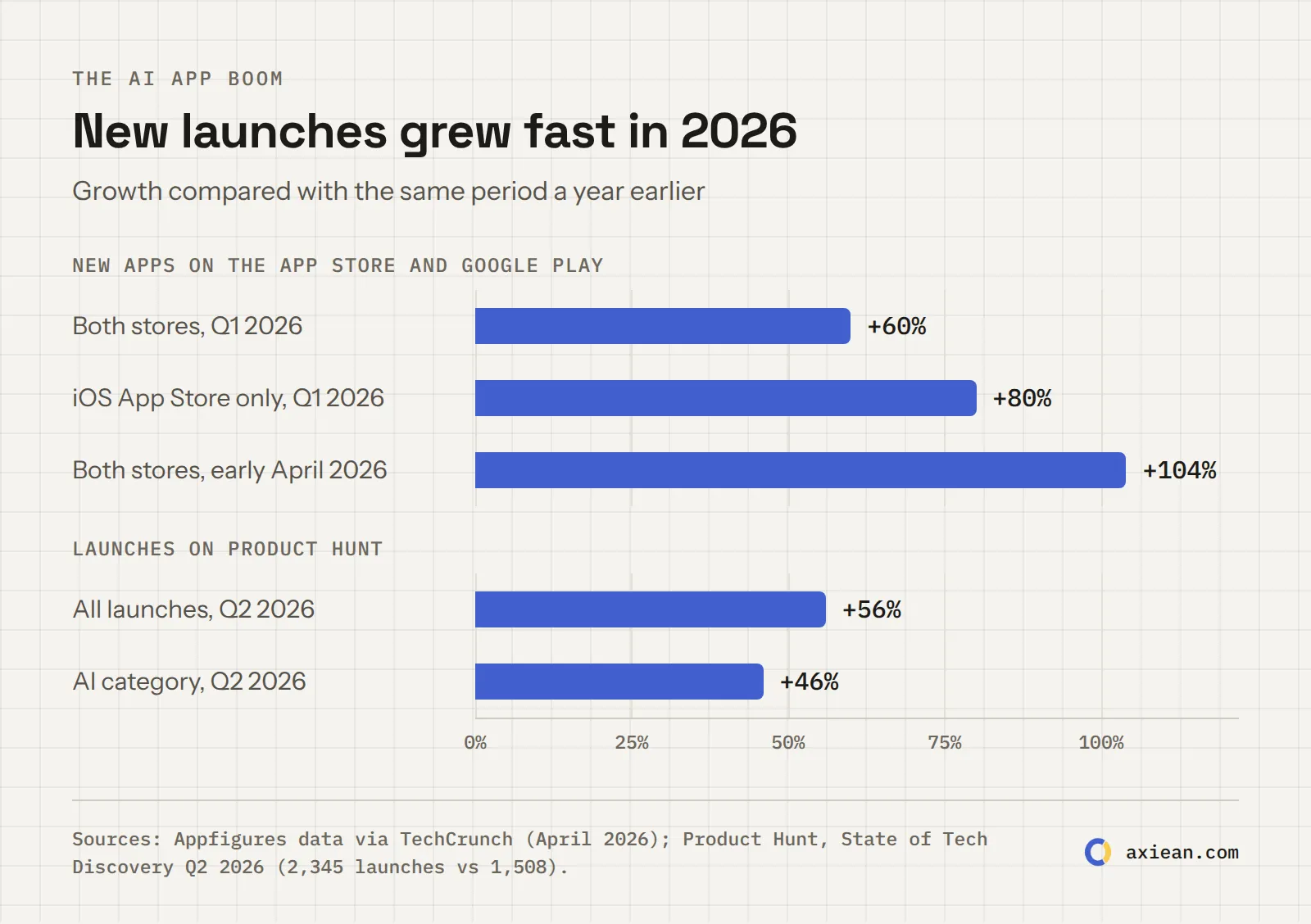
New app releases grew about 60% in one year (Q1 2026, both app stores, Appfigures data). On the iOS App Store alone, the growth was about 80%.
Product Hunt had 2,345 launches in Q2 2026, up from 1,508 a year before. AI was the biggest category, with 1,111 launches.
More launches means less attention for each one. A single launch day is not enough anymore.
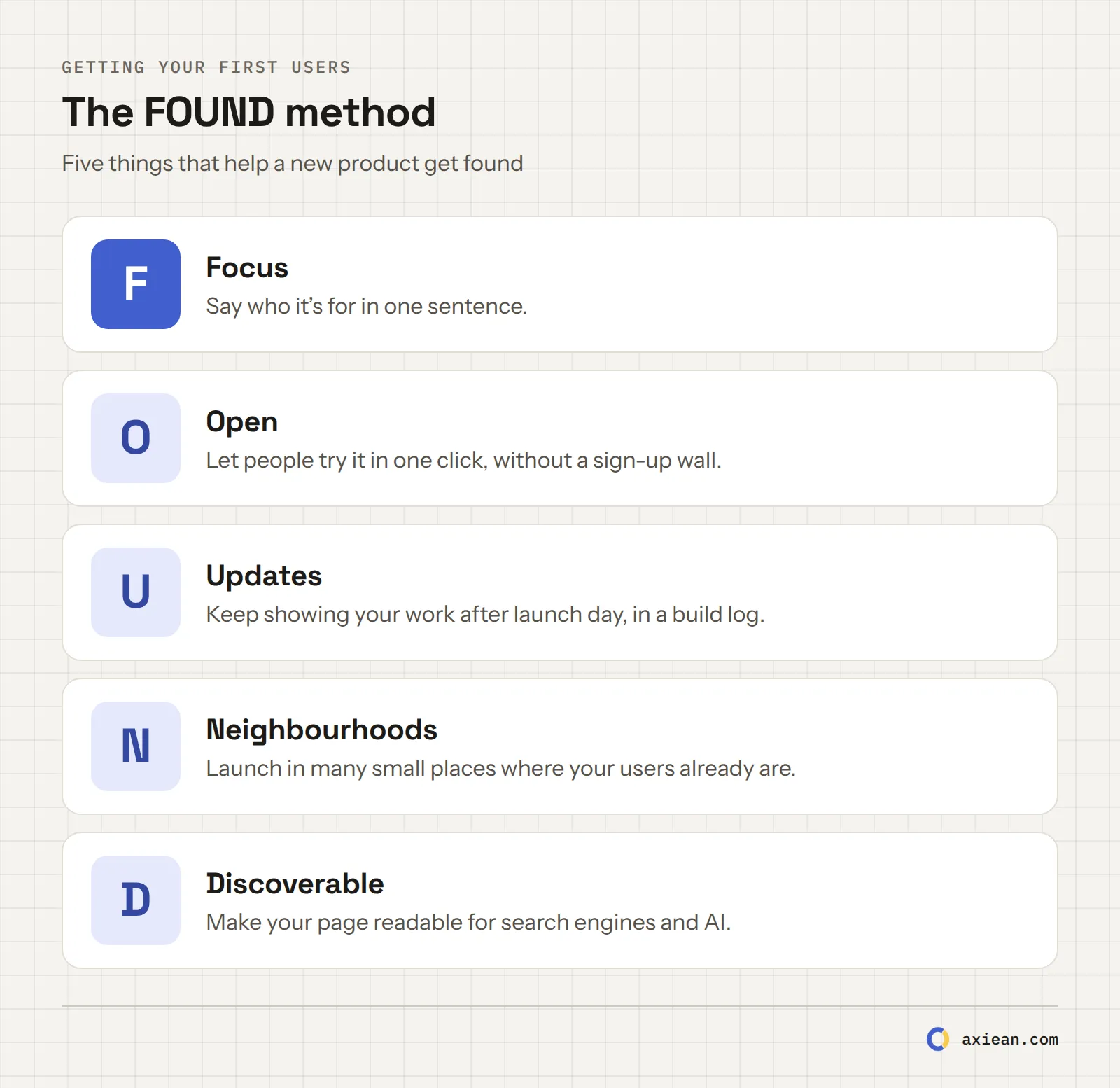
Your first users come from five things. I call them FOUND: Focus, Open, Updates, Neighbourhoods, Discoverable.
Below you'll find each step, a 30-day plan, and answers to the questions makers ask most.
Building got cheap: the numbers
If you feel like everyone is launching something right now, you're right. Here is what the data shows.
"Vibe coding" became normal. Collins Dictionary chose vibe coding as its Word of the Year for 2025. It means using AI, prompted in plain language, to write code. The term only appeared in February 2025.
Even funded startups build this way. In March 2025, Y Combinator's Jared Friedman said that a quarter of the startups in its Winter 2025 batch had codebases that were about 95% generated by AI.
More developers, more projects. GitHub's Octoverse 2025 report says more than 36 million developers joined GitHub in one year, about one every second, and 121 million new repositories were created in 2025.
More launches everywhere. According to Appfigures data reported by TechCrunch, new app releases in Q1 2026 were up 60% year over year across the App Store and Google Play, and 80% on iOS alone. In early April 2026 the number was up 104%. On Product Hunt, the Q2 2026 report counted 2,345 launches, up from 1,508 in Q2 2025, and more than 61% of the people launching AI products were launching there for the first time.
Year-over-year growth in new launches. Sources: Appfigures via TechCrunch (April 2026), Product Hunt Q2 2026 report.
One honest note: nobody has proven that AI caused all of this. TechCrunch calls it a "working hypothesis." But if you build products today, you can feel it. The cost of making something that works has dropped close to zero for many kinds of software.
Getting found didn't: why more launches means less attention
The number of people who might use your product didn't grow 60% in a year. Their time didn't grow either. So when the number of launches goes up fast, each launch gets a smaller share of attention.
Here is what that looks like in practice:
Launch day is more crowded. Every big launch site has a homepage with limited space. More products on the same day means fewer eyes on yours.
The spike is shorter. A good launch day still brings visitors, but they stop coming the next day, because the next day has its own launches.
People trust less. In the Stack Overflow Developer Survey 2025, 84% of developers said they use or plan to use AI tools, but more of them distrust the accuracy of AI output (46%) than trust it (33%). Users feel the same about "yet another AI app." They are careful, and they should be. (If you built fast, read my security checklist for vibe-coded apps before you launch.)
So the old advice, "build it, then post it on Product Hunt," is not wrong. It's just not enough on its own anymore.
The FOUND method: five steps to your first users
When I look at small products that do get their first users, they almost always do the same five things. I put them together under one simple name so they're easy to remember.
The FOUND method: five things that help a new product get found.
F: Focus. Say who it's for in one sentence
Most new products describe what they are. Users want to know who they're for.
Use this sentence and fill in the blanks:
[Product] helps [specific people][do a specific job] without [the usual pain].
For example: "This app helps freelance designers send invoices from their phone without opening a spreadsheet." That sentence tells the right person, in five seconds, that this is for them.
A quick test: show your sentence to a friend, wait a minute, and ask them to repeat it. If they can't, it's too vague.
This step matters for search too. A specific page is easier to recommend, for a person and for an AI answer. "A tool for freelance designers to send invoices" can match a real question. "An AI-powered productivity platform" matches nothing.
O: Open. Let people try it in one click
Every step between "I'm curious" and "I'm using it" loses people. The biggest wall is the sign-up form.
Hacker News says it clearly in its Show HN rules: make it easy for users to try your thing out, "ideally without barriers such as signups or emails."
Ideas that work:
A demo mode with sample data, no account needed.
A short video (under a minute) of the main thing it does.
Sign-up only when the user wants to save something.
And because an open door brings in strangers, make sure it's safe. AI-built apps often ship with keys in the browser or open databases. My vibe coding security checklist covers 20 checks you can do in an afternoon.
U: Updates. Keep showing your work
One launch day is one chance. Regular updates give people many chances to notice you.
When you share what you built this week, what broke, and what you learned, three good things happen:
People who missed your launch see you later.
People who saw it but weren't ready get a reason to come back.
Search engines and AI tools find fresh pages about your product.
This is why every project on Axiean has a build log: short entries on the project's page about what changed. People who follow you get a notification when you post one, and new entries appear in the feed. You can see how it looks on Axiean's own project page.
You don't need to write a lot. Three or four sentences a week are enough. Write the way you'd tell a friend.
N: Neighbourhoods. Launch in many small places
Your first users are not "everyone on the internet." They're a few hundred people who already talk about the problem you solve, somewhere.
So instead of one big launch day, plan many small ones:
Two rules for every place: read its rules before posting, and stay to answer every comment that day. A launch you post and leave usually doesn't go anywhere.
D: Discoverable. Make it readable for search engines and AI
This is the step most AI-built products skip, and it matters more every month.
Many apps made with AI builders are single-page apps: the server sends an almost empty page, and JavaScript builds the content in the browser. Google can usually run that JavaScript. But a Vercel study of AI crawlers found that the major AI crawlers, including GPTBot and ClaudeBot, don't run JavaScript at all. For them, your beautiful app can be an empty page.
The basics:
Have at least one page about your product that works without JavaScript: a landing page, or a server-rendered page.
Give it a clear title and description that say who it's for (step F again).
Don't block the AI search crawlers by accident (check your robots.txt and your hosting or CDN settings).
Get listed on a few trusted sites that link to you.
A project page on Axiean helps here: it's rendered on the server, with structured data (SoftwareApplication) that machines can read, in three languages. So even if your own app is a single-page app, there's a clean, readable page about it. The GEO guide goes deeper.
A 30-day plan for your first 100 users
Here's how the five steps fit into one month. "100 users" is a target to aim for, not a promise. Some products get there in a week, many take longer, and that's normal.
When
Do this
You're done when
Before launch
Write your one-sentence focus. Remove the sign-up wall or add a demo. Run the security checklist. Check that your main page is readable without JavaScript.
A stranger understands it and can try it in under a minute.
Week 1
Launch on Axiean and in one community where your users are. Write your first build log entry.
You have answered every comment.
Week 2
Post a Show HN or post in a second community. Fix the top three problems people mention.
You've shipped at least one fix and written about it.
Week 3
Launch on Product Hunt, Uneed or Peerlist. Post a build log entry about what the first users taught you.
You have a list of real user feedback.
Week 4
Write one useful article about the problem you solve (not about your product). Ask your first users what they'd tell a friend about it.
You know which sentence makes people click.
Repeat weeks 2 to 4 with new places and new updates. Getting found is not a single event. It's a habit.
Why I'm building Axiean for this
When I started Axiean, the idea was simple: products built with AI need a place where they can be found, and where the people who make them can show their work over time, not just on one day.
On Axiean, you publish your project for free, say which AI tools and technologies you used (shown as self-reported), and keep a build log. People can vote, save, comment and follow you. Projects appear in daily launches and in discovery by category, AI tool and technology.
To be honest: Axiean is brand new. It went live in October 2026, and the community is small. I'm following the plan above myself. If you're building something with AI, I'd love to see it: publish your project here. You can read more about why I started it on the About page.
Frequently asked questions
How do I get my first users for an app built with AI?
Be specific about who it's for, let people try it without signing up, post regular updates, launch in several small communities where your users already are, and make sure search engines and AI tools can read your page. That's the FOUND method above.
Is Product Hunt still worth it in 2026?
Yes, as one step among several. It's free, and a good day there brings real visitors. But with more than 2,300 launches a quarter, one day is a short window. Plan what you'll do the week after. See Product Hunt and 8 alternatives compared.
Should I say that my product was built with AI?
On Axiean, yes: makers declare the AI tools they used, and it's shown as self-reported. Elsewhere it's your choice. I believe being open about how you build makes people trust you more, not less, as long as the product works and is safe.
How long does it take to get 100 users?
There's no fixed number. For a small product with a clear focus, a few weeks to a few months is normal. If you're not getting anywhere after a month, the problem is usually step F: the sentence about who it's for.
Is a fast-built app good enough to launch?
If it solves a real problem, works, and is safe, yes. Speed of building is not the problem. Skipping the security basics and the "who is it for" question is.
AI writes code fast, but it doesn't always lock the doors. Here are 20 security checks for apps built with Lovable, Bolt, Cursor, Claude Code or any AI tool, each with a quick test and a prompt you can give your AI. Based on real incidents from 2025 and 2026.
Product Hunt, Hacker News, Reddit, BetaList, Uneed, Peerlist and more, compared with their real rules and prices as of October 2026. Which one fits your product, what each costs, and how to combine them into one launch plan.
··11 min read
People now ask AI tools which product to use. If they can't read your site, you're not in the answer. A practical guide to generative engine optimization (GEO) for makers, with the exact crawler names, a 2-minute test, and what we set up on Axiean.

 Vahid Aslani