Where to Launch Your Product in 2026: Product Hunt and 8 Alternatives, Honestly Compared
Product Hunt, Hacker News, Reddit, BetaList, Uneed, Peerlist and more, compared with their real rules and prices as of October 2026. Which one fits your product, what each costs, and how to combine them into one launch plan.
··11 min read
"Where should I launch?" is a question I've asked myself many times in ten years of building my own products. It's also the question I hear most from people building with AI. They can now build in a weekend, and then they get stuck at this step for weeks.
So I went through the main launch sites, read their actual rules and pricing pages (in October 2026), and wrote down what each one is good for. Axiean is on the list too, because it's my platform, and I'll be clear about where it's strong and where it's still small.
This is a companion to my guide on . That one explains why one launch day isn't enough. This one is about where.
In short
No single site is enough. The best results come from several small launches in places where your users already are.
Product Hunt is still free and still big, but busy: 2,345 launches in Q2 2026, and AI was the largest category.
Hacker News (Show HN) is great for developer tools, but only for things people can try right now.
BetaList is for pre-launch and just-launched startups, and it needs a real landing page.
Uneed launches at least 30 free products every day. Paid options ($14.99 or $39.99) only get you an earlier date.
"Built with AI" and "AI tool" are not the same. AI tool directories only fit products where AI is the product. Axiean is for any product that AI helped you build.
The quick comparison
Platform
Best for
Cost (Oct 2026)
The rule that matters most
Product Hunt
Most kinds of software
Free
The product must be new and usable. Hunt it yourself.
Hacker News (Show HN)
Developer and technical products
Free
It must be something people can try. No landing pages.
Reddit
Niche tools and consumer apps
Free
Every subreddit has its own self-promotion rules.
Indie Hackers
Products for founders and small SaaS
Free
Share real lessons and numbers, not ads.
BetaList
Pre-launch and just-launched startups
Free (wait days to weeks) or paid (a few days)
It needs its own landing page, not a free subdomain.
Uneed
Indie products and tools
Free (30+ days wait), $14.99 or $39.99 for an earlier date
You need an upvote score of 10 to stay listed.
Peerlist Launchpad
Developers and designers
Free
The project must be complete on your Peerlist profile.
There's An AI For That
Products where AI is the product
Usually paid
It only fits AI tools.
Axiean
Any product built with AI's help
Free
Declare the AI tools you used.
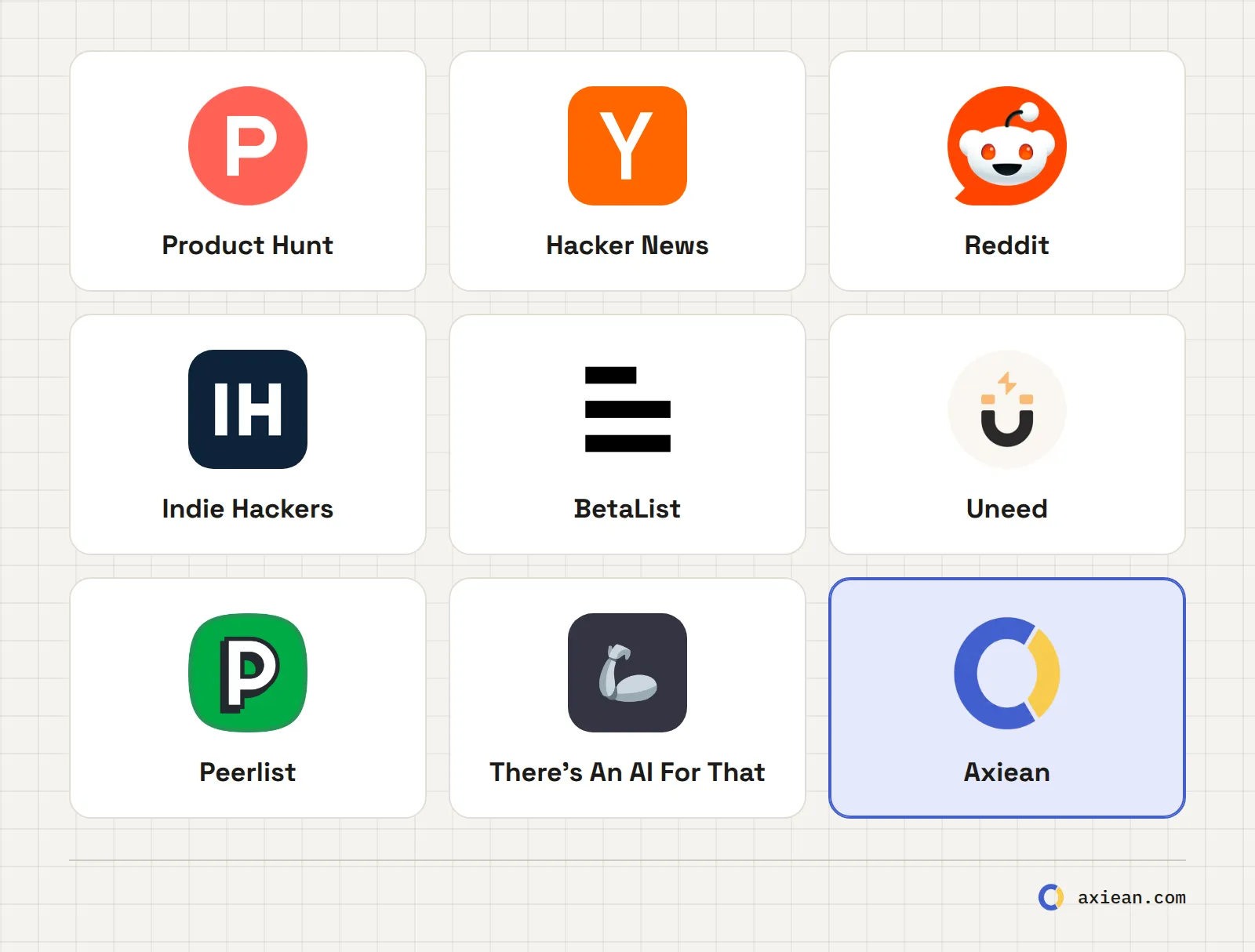
The nine launch platforms compared in this post.
How to choose: three questions
Before you pick, answer these three questions honestly.
1. Can people try it today? If not, you're in pre-launch. BetaList and a waiting list on your own site are your tools. Show HN and Product Hunt want something people can use.
2. Who are your first users? Developers live on Hacker News, Peerlist and some subreddits. Founders read Indie Hackers. Everyone else lives in communities about their hobby or job, and that's where you should be.
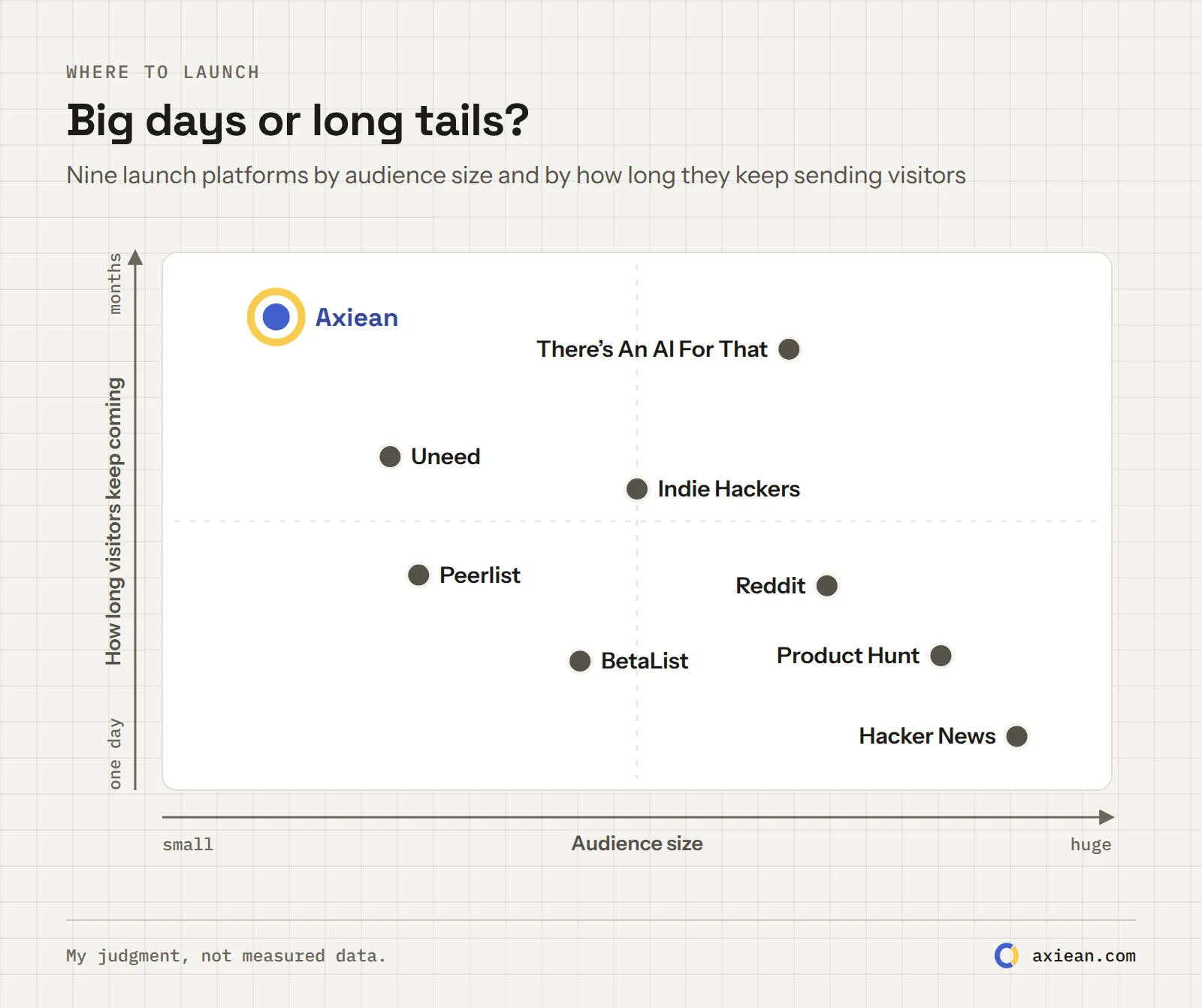
3. Do you want a spike or a stream? Some places give you one big day. Others give fewer visitors, but for longer, because your page stays there and keeps getting found.
I put the nine platforms on one map to show that last trade-off. It's my own judgment, not measured data, but it's how I think about it.
My view of the trade-off: audience size against how long visitors keep coming. Not measured data.
The nine platforms, one by one
1. Product Hunt
What it is: the best-known daily launch site for tech products.
The real rules (from its launch guide): it's "100% free to use." Makers are encouraged to hunt (post) their own products. Company or brand accounts can't post or comment. The product should be new and usable, so closed betas are usually not a good fit. Product of the Day is decided by "a confidential algorithm" that looks at upvotes, time since posting and other factors. And: "Please do not pay anyone to hunt or send traffic to your product."
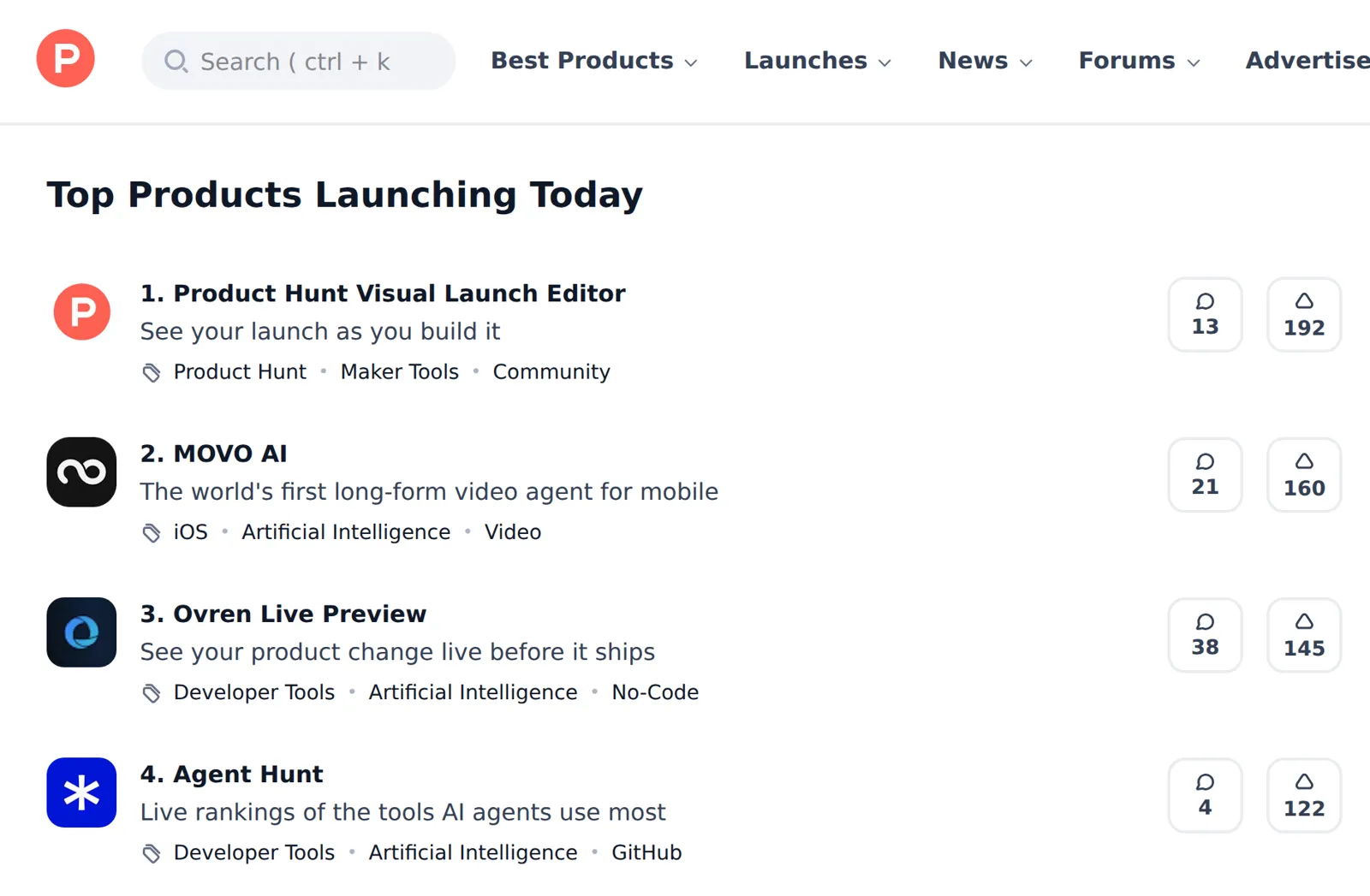
The numbers: Product Hunt's own Q2 2026 report counted 2,345 launches in the quarter (up from 1,508), 1,111 of them in the AI category. AI launches averaged 252 upvotes, against 190 for all launches.
Product Hunt's homepage, October 2026.
My tips:
Launch when you can be online all day to answer comments.
Your first line should say who it's for, not how smart the technology is. In a category with over a thousand AI launches a quarter, "AI-powered" says nothing.
Ask people to try it and leave honest feedback, not to upvote.
Watch out: it's crowded. A good day brings visitors, but plan what happens the week after.
2. Hacker News (Show HN)
What it is: a news site for programmers and tech people, run by Y Combinator. "Show HN" posts are for things you made.
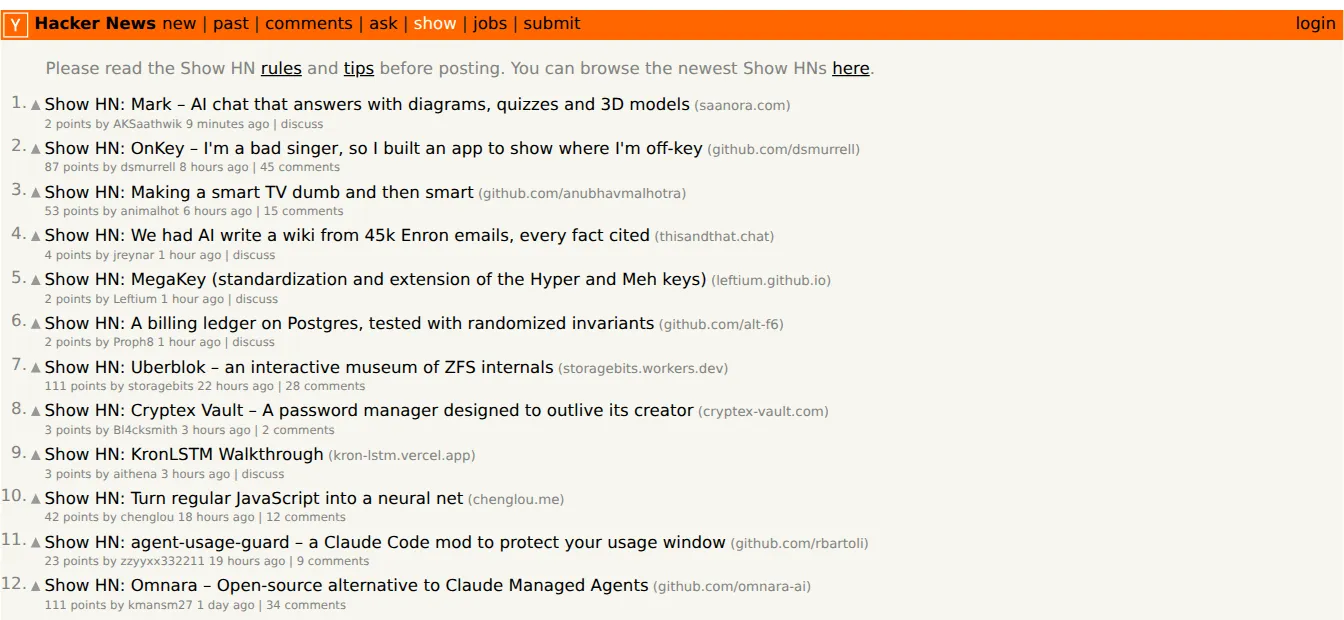
The real rules (from the Show HN guidelines): "Show HN is for something you've made that other people can play with." Blog posts, sign-up pages and newsletters are off topic. "Don't post landing pages or fundraisers." Make it easy to try, "ideally without barriers such as signups or emails." And one rule that matters a lot for AI-built products: "The project should be non-trivial. Don't post quickly-generated one-offs."
The Show HN page on Hacker News.
My tips:
Title format: Show HN: Name – what it does in plain words.
Post a first comment yourself: why you built it, how it works, what you're unsure about. The guidelines say it well: "Share something that is deeply personal and interesting to you. Explain how and why."
Being open about building with AI is fine. Showing that you understood and shaped what the AI wrote is what earns respect.
Watch out: feedback is direct, and you'll get it all in a few hours. Don't ask friends to upvote. The guidelines forbid it, and it's easy to notice.
3. Reddit
What it is: thousands of communities (subreddits), each with its own topic and its own rules.
The real rules: they're different in every subreddit, and they change. Many communities allow self-promotion only in a weekly thread, or only if you also take part in other discussions. Always read the rules in the sidebar before you post.
My tips:
The biggest opportunity is in niche subreddits about the problem you solve, not in general startup subreddits. A recipe app does better in a cooking community than in r/SideProject.
Write as a person, not a brand: "I built this because I had this problem. Here's what I learned." Then ask a real question.
Answer every comment, including the negative ones.
Watch out: posting the same text in ten subreddits on the same day looks like spam, and moderators remove it.
4. Indie Hackers
What it is: a community of founders building small, independent businesses. People share how they got users and revenue.
My tips: don't post an announcement. Post a story with real numbers and lessons: "I built X in two weekends with an AI agent. Here's what worked and what didn't." Those posts get read, and readers click through to the product on their own.
Watch out: the audience is mostly other founders. Great if your product is for founders, less useful if it's a consumer app.
5. BetaList
What it is: a site that features early-stage startups, before or just after launch.
The real rules (from BetaList's criteria): products can be featured up to twice, "once pre-launch and once at launch," a few weeks apart. Accepted: pre-launch landing pages, invite-only betas, and products launched "ideally within the last few weeks." It needs "a distinct, decent-looking landing page." Pages on hosted page builders like Carrd, or on free subdomains like yourapp.vercel.app, are listed as pitfalls. BetaList features "around 20 new startups every day." Free submissions usually wait "days or weeks," and a paid plan gets you featured "within days."
My tips: use it before your main launch to collect a waiting list. Buy your own domain first. It's one of the requirements, and it's worth it anyway.
Watch out: it brings early adopters, not a flood. Have a way to collect emails on your page.
6. Uneed
What it is: a daily launch site for indie products, with a calmer pace than Product Hunt.
The real rules (from Uneed's pricing and how-it-works pages): every day at 12:00 AM PST, a new batch goes live, with "at least 30 free launches from the waiting line, plus every paid launch." The free line gives you a date "at least 30 days out." Paid options only change the date: Fast-track ($14.99, about two weeks out) or Skip the waiting line ($39.99, any date you want). You need an upvote score of 10 to stay published and 20 to get a do-follow backlink.
My tips: take the free line and use the waiting time to prepare. Schedule it in the same weeks as your other launches, so they help each other.
Watch out: with a score under 10, your launch goes back to your dashboard and can't join the free line again. Bring a few real users with you.
7. Peerlist Launchpad
What it is: the launch section of Peerlist, a professional network for people who build software.
The real rules (from the Peerlist help center): the launch window opens on Monday every week and runs for the week. Only projects that are 100% complete on your Peerlist profile can launch. Winners get a badge and are featured in Peerlist's newsletter and social channels.
My tips: complete your profile and the project page a few days before. The audience is developers and designers, so be specific about how you built it.
Watch out: the audience is smaller and mostly technical.
8. There's An AI For That (and other AI tool directories)
What it is: a large directory of AI tools, where people search for "an AI for" a task.
My tips: this only fits if AI is the product, like an AI writing assistant or an AI image tool. If you built a habit tracker with AI's help, but it has no AI features, this is the wrong shelf. Listing is usually paid, so check the current price on their submit page first.
Watch out: this is the most common mistake I see. "Built with AI" and "AI tool" are different things. Don't pay to be listed in the wrong place.
9. Axiean
What it is: my platform, made for products built with AI's help, of any kind: apps, games, developer tools, websites and experiments. The product doesn't need AI features of its own. AI just has to have meaningfully helped build it.
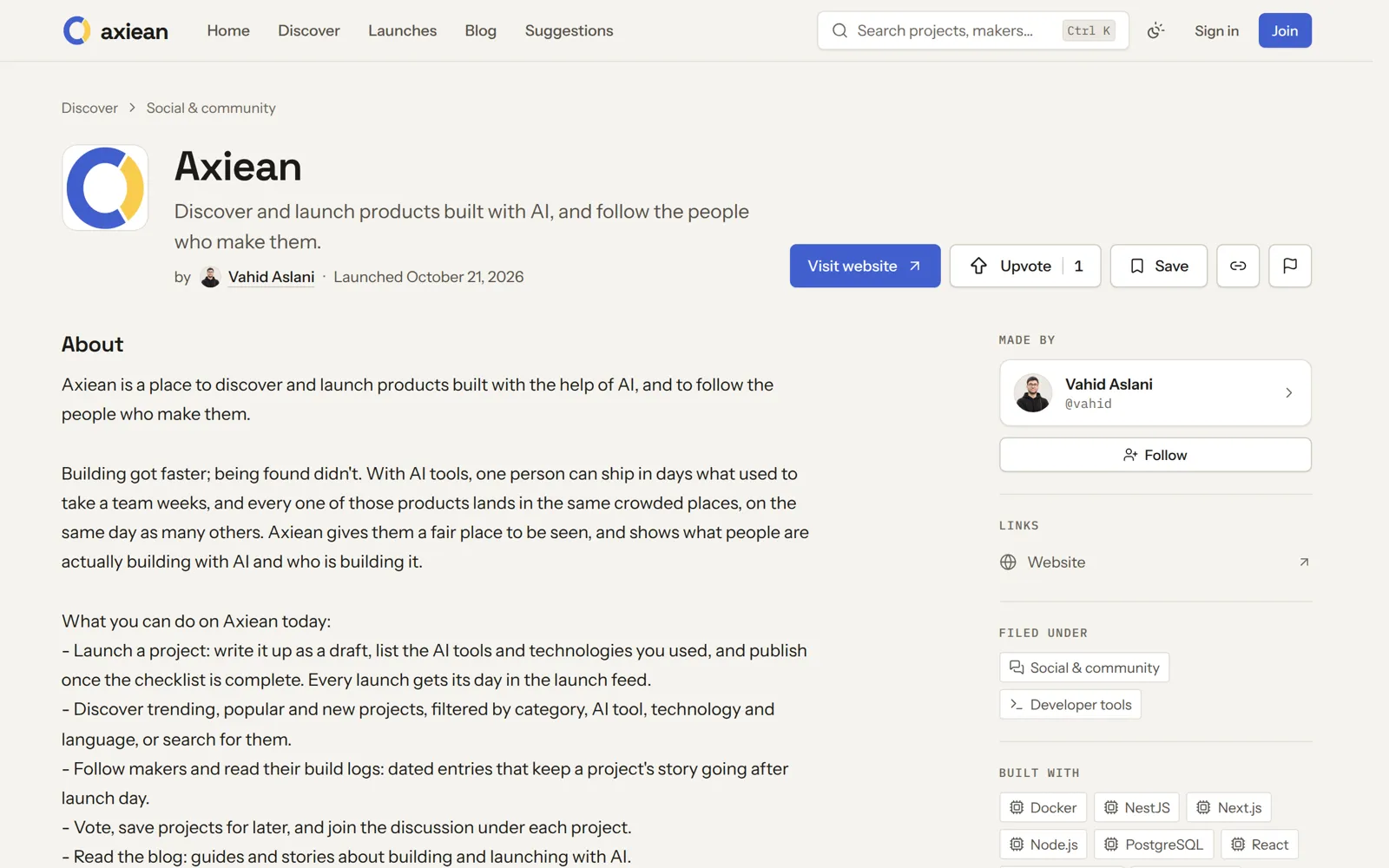
How it works: publishing is free. You say which AI tools and technologies you used, and the page shows them as self-reported. Your project gets a permanent page with votes, comments and saves. It appears in daily launches, in the trending, popular and new feeds, and on the pages for its category, AI tools and technologies in discovery. Your build log keeps the page alive after launch day: people who follow you get notified when you post. Every page is rendered on the server, with structured data, in English, Spanish and Turkish, so search engines and AI tools can read it. (I explain why that matters in my GEO guide.)
A project page on Axiean: Axiean's own, published by its maker.
Honestly: Axiean went live in October 2026, so the audience is still small. Don't expect a Product Hunt-sized day. Expect a page that stays useful: one place that shows what you built, how you built it, and what you've changed since.
Launch sites are borrowed audiences. Your own channels (X, LinkedIn, Bluesky, a newsletter, even a short email to people who know you) are where your first 20 users often come from. Post the same story there: what you built, who it's for, what you learned.
A launch plan that combines them
Here's how I'd use them together for one product. Adjust the order to your audience.
When
Where
Why
4–6 weeks before
BetaList (pre-launch), join Uneed's free line
Collect a waiting list. Get a date.
Launch week, day 1
Axiean, your own channels
A permanent page, and the people who already know you.
Launch week, day 2–3
Show HN (if technical) or one niche subreddit
Honest feedback from people who care about the problem.
Yes. Its launch guide says it's "100% free to use," and it asks makers not to pay anyone to hunt or send traffic to their product.
What is the best free alternative to Product Hunt?
It depends on your users. For developer tools: Show HN and Peerlist. For founders: Indie Hackers. For any product built with AI: Axiean. For a steady daily launch: Uneed's free line. Most products should use two or three of them.
Should I launch everywhere on the same day?
No. Spread your launches over a few weeks. You'll learn from each one, fix things in between, and arrive at the bigger sites with a better product.
Do launch sites help SEO?
A little. Some give links that search engines follow (Uneed gives a do-follow link from an upvote score of 20). More important is having permanent, readable pages about your product on trusted sites. Those are what search engines and AI answers find later.
Can I launch a product that I built mostly with AI?
Yes, everywhere on this list. But Show HN asks for non-trivial projects, not "quickly-generated one-offs," and every audience can tell when nobody thought about the details. Make it solid before you show it.
Sources
All rules and prices were checked on the platforms' own pages in October 2026. They change, so check again before you launch.
AI writes code fast, but it doesn't always lock the doors. Here are 20 security checks for apps built with Lovable, Bolt, Cursor, Claude Code or any AI tool, each with a quick test and a prompt you can give your AI. Based on real incidents from 2025 and 2026.
AI made building an app fast and cheap, so everyone is launching. Now the hard part is getting found. Here are the real numbers behind the change, and the simple five-step method I use to get the first users for a product built with AI.
··10 min read
People now ask AI tools which product to use. If they can't read your site, you're not in the answer. A practical guide to generative engine optimization (GEO) for makers, with the exact crawler names, a 2-minute test, and what we set up on Axiean.
 Vahid Aslani