Made with AI, Not AI Slop: How to Make People Trust a Product You Built with AI
"Slop" was Merriam-Webster's word of 2025, and people now look for signs of it. What makes an AI-built product feel like slop, what makes it feel cared for, whether you should say you used AI, and what Google, the FTC and the EU AI Act say in 2026.
··11 min read
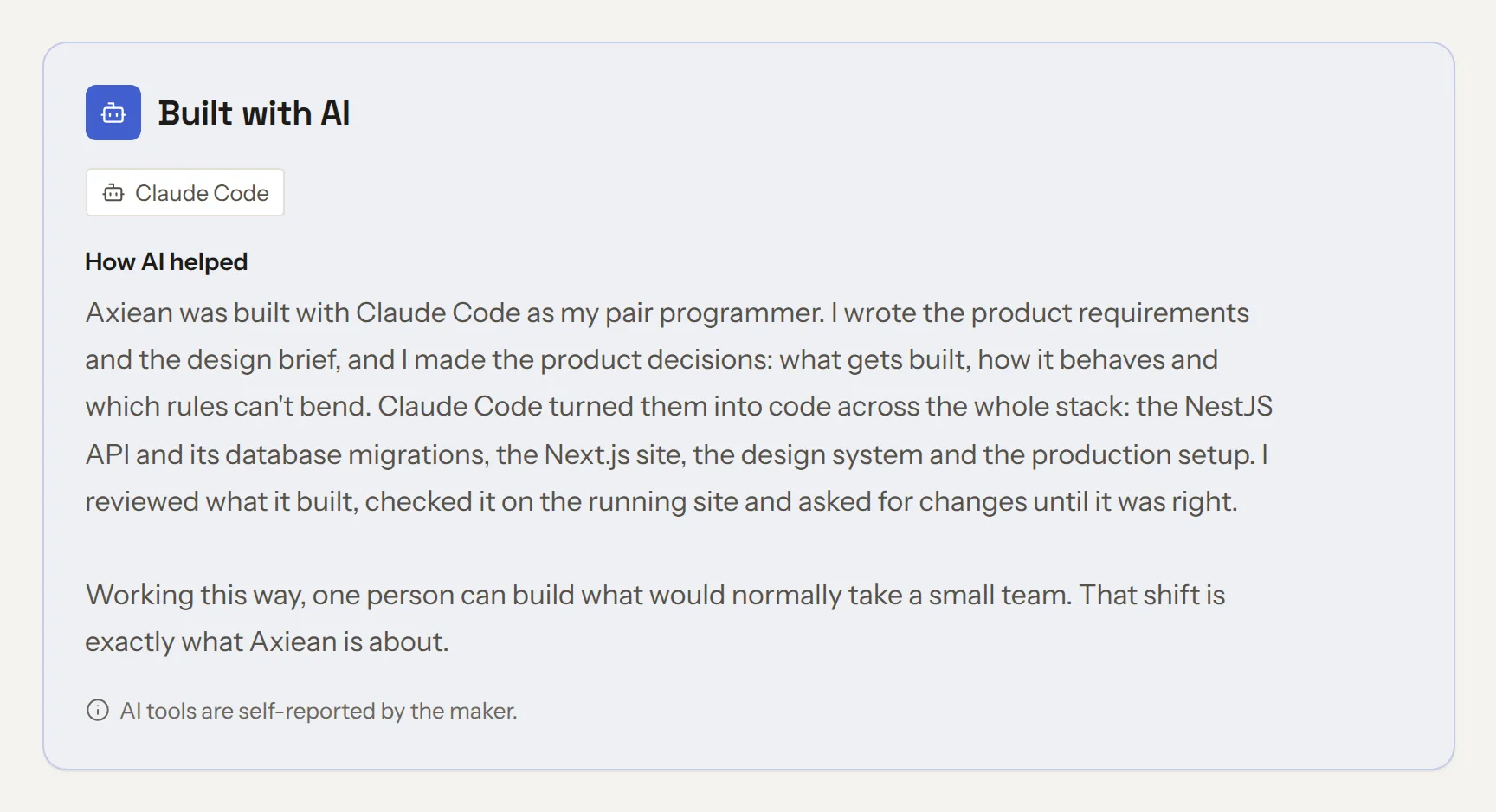
I build with an AI coding agent, Claude Code, and I don't hide it. It's listed on Axiean's own project page, in the AI tools section, like on every other project here.
But I understand why some makers ask me whether they should hide it. In 2025, "slop" became the word for low-quality content made with AI, and many people now look at anything built with AI and wonder if it's more of the same.
My answer: don't hide it. Being built with AI isn't the problem. Being built without care is. This post is about the difference: what makes a product feel like slop, what makes people trust it, how to say you used AI, and what the rules say in 2026.
In short
AI slop is low-quality content made with AI, usually in large amounts, with little care. Merriam-Webster chose "slop" as its Word of the Year for 2025.
People judge signs of care, not the tools: a specific promise, real screenshots, a real person behind it, honest limits, no fake reviews, updates after launch.
Say how you built it, plainly, where people would wonder. Google's guidance says AI disclosures are useful where someone might ask "How was this created?"
Fake reviews are illegal in the US, AI-written ones included, and in the EU, AI features that talk to people or create images, audio or video come with labelling duties since August 2026.
Below: the signs of slop and care, a 12-point trust checklist, disclosure templates you can copy, and how Axiean handles it.
What is AI slop?
AI slop is low-quality digital content made with AI, usually in large amounts and with little human care: generic articles, fake-looking images, copy-paste apps and products that look like a hundred others.
Two dictionaries made it their word of 2025. Merriam-Webster chose "slop", defined as "digital content of low quality that is produced usually in quantity by means of artificial intelligence" (TechCrunch, 15 December 2025). Australia's Macquarie Dictionary chose "AI slop" a few weeks earlier (Euronews).
Look at those definitions again: low quality, in quantity. Neither says "made with AI" is the problem by itself. Slop is what happens when AI makes it so cheap to produce things that people stop caring whether they're good.
Why people trust AI-built products less right now
There are more products than ever, and many of them were built in a weekend. I wrote about the numbers behind the launch boom: new app releases grew about 60% in a year.
Even developers, who use AI every day, are careful. In the Stack Overflow Developer Survey 2025, 84% said they use or plan to use AI tools, but more of them distrusted the accuracy of AI output (46%) than trusted it (33%).
So users have learned to look for signs. They don't ask "was this built with AI?" first. They ask "did anyone care about this?" Your job is to make the answer obvious.
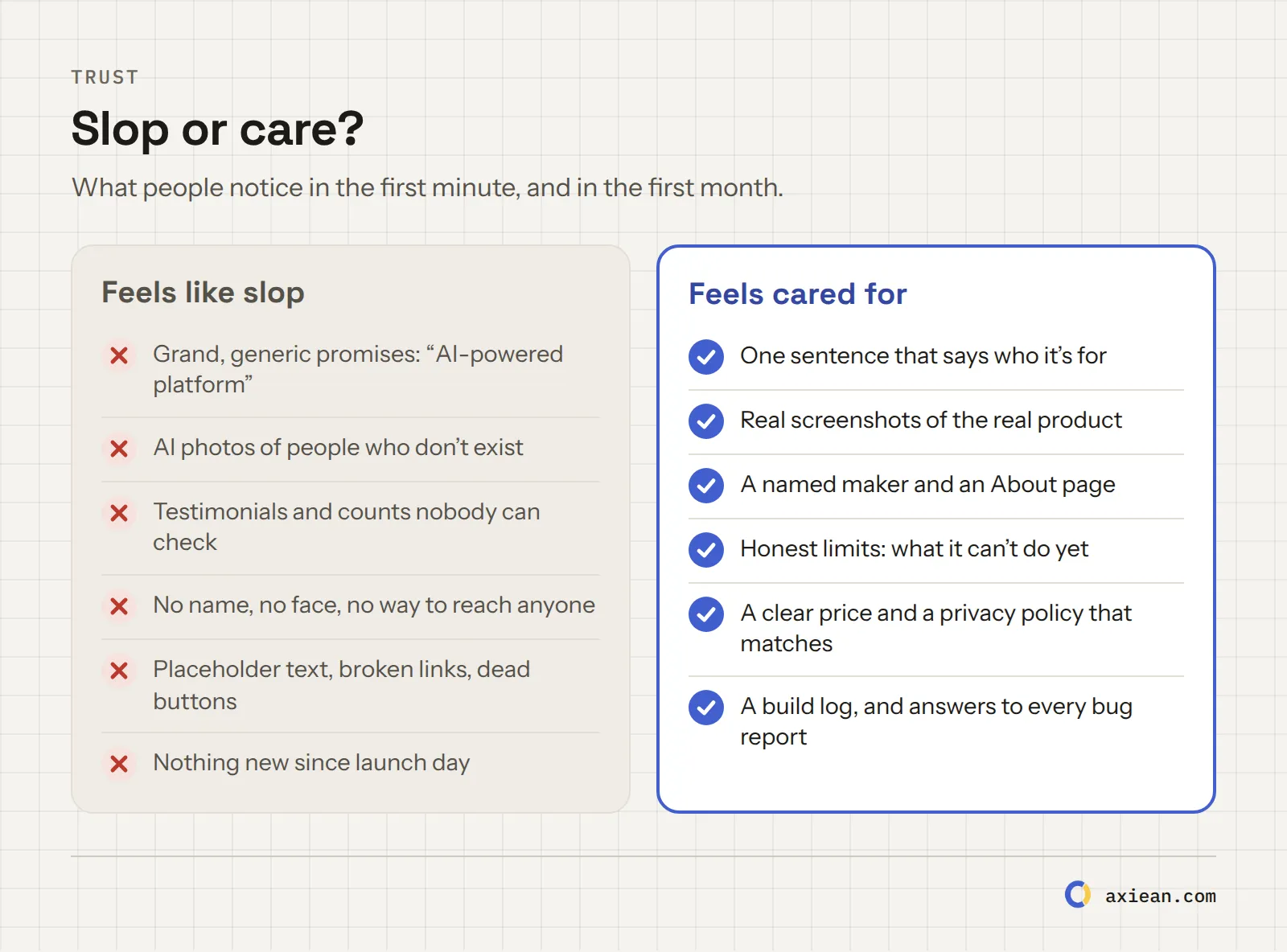
The signs: slop or care?
What people notice in the first minute, and in the first month.
Most of these signs have nothing to do with AI. A product built by hand can feel like slop, and a product built mostly by AI can feel carefully made. The difference is the work around the code: deciding who it's for, checking it, answering people and staying around.
The trust checklist: 12 things to do before you launch
Say who it's for in one sentence. "Helps freelance designers send invoices from their phone" beats "an AI-powered productivity platform". (This is step F in my first users guide.)
Show the real product. Real screenshots or a short screen recording, not AI-generated mockups of screens that don't exist.
Put a real person behind it. Your name, a photo if you're comfortable, a short About page and a way to contact you.
Never fake social proof. No invented testimonials, no logos of companies that don't use you, no made-up user counts. In the US this is now illegal, as you'll see below.
Say what it can't do yet. A short "limits" or "not yet" list makes everything else more believable.
Say how you built it, plainly, in the places people would ask. Templates are below.
Label AI inside the product. If a feature writes text, answers questions or makes images with AI, say so where people see the result.
Make the price and cancelling clear. No hidden fees, no maze to cancel.
Write a privacy policy that matches your code, including which AI services see users' data. My post on the last 20% covers this and eleven other things AI usually leaves unfinished.
Answer people. Every bug report, comment and question in the first weeks. Fast, personal answers are the opposite of slop.
Should you say you used AI?
Yes. Not as an apology, and not as a buzzword, but as a plain fact in the places where people would wonder.
That's close to what Google says. Its guidance on AI-generated content (February 2023) says AI or automation disclosures "are useful for content where someone might think 'How was this created?'", and suggests adding them when readers would reasonably expect them. It also says giving the AI an author byline is probably not the best way to do it: a person should stand behind the content.
Different places have found the same balance. When Valve changed its Steam disclosure form in January 2026, it said that efficiency gains from AI tools in development aren't the focus; what must be disclosed is AI-generated content that players actually see and hear.
So there are two kinds of disclosure:
What users meet (AI answers, AI images, AI voices): always label it, at the point where they meet it.
How you built it (AI coding tools): say it on your About page, in your FAQ or on your project page. It's not legally required for the code itself in most places, but it's honest, it's a good story, and it helps other makers learn.
On Axiean, makers declare the AI tools they used, because Axiean is a place for products built with AI. Seeing which tools other makers use is part of what makes it useful.
Disclosure templates you can copy
A short line (footer, FAQ or store listing):
Built by [your name] with the help of AI coding tools ([tools]). I review and test every change.
A paragraph for your About page:
I'm [name], [one line about you]. I build [product] with AI coding tools: they write much of the code, and I decide what to build, check the changes, test them and answer for the result. If something's wrong, [how to reach you].
Inside an AI feature:
This answer was written by AI and can contain mistakes. Check important details.
This image was generated with AI.
Keep it short, specific and true. Don't claim a human did something an AI did, and don't call a product "100% AI-built, zero humans" as a boast if a human is responsible for it, because a human is.
What the rules say in 2026
This is a short overview for makers, not legal advice. Rules change, so check the current text if they apply to you.
Who
What it says
It matters to you if
Google Search
Quality matters, not how content is made. Mass-produced pages with little value are spam, however they're made.
You want people to find you on Google
US FTC rule on fake reviews (since 21 October 2024)
Fake reviews and testimonials are banned, AI-written ones included, and so is buying fake followers or views
You sell to people in the US
EU AI Act, Article 50 (since 2 August 2026)
Chatbots must make clear people are talking to an AI; AI-generated images, audio, video and text must be marked as such; deepfakes must be labelled
Your product has AI features used by people in the EU
Steam (since January 2024, updated January 2026)
Disclose AI-generated content players see; AI tools used only in development aren't the focus
You sell games on Steam
Google: quality, however it's made
Google's 2023 guidance says that "appropriate use of AI or automation is not against our guidelines" and that it rewards high-quality content however it's produced. In March 2024 it added a spam policy against scaled content abuse: making large amounts of unoriginal pages with little value, "no matter how it's created".
For makers, that means one genuinely helpful page about your product is worth more than a hundred generated ones. My GEO guide explains what makes a page worth quoting for AI search too.
FTC: no fake reviews, AI-written or not
The US Federal Trade Commission's rule on fake reviews and testimonials took effect on 21 October 2024. It bans reviews and testimonials that misrepresent who wrote them or their experience, including ones generated by AI, and buying fake signs of social media popularity. The FTC can ask for civil penalties for each violation.
Asking an AI to write "customer quotes" for your landing page is exactly what this rule is about. Use real quotes with permission, or none.
A system that talks with people, like a chatbot, must make it clear they're talking to an AI, unless that's obvious.
AI systems that generate images, audio, video or text must mark their output as AI-generated in a machine-readable way.
Deepfakes must be disclosed, and so must AI-generated text published to inform the public on matters of public interest, unless a person has reviewed it and takes editorial responsibility.
These rules are about what your AI features show to people, not about whether AI helped you write your code.
How Axiean handles it
I built Axiean around being open about AI, so here's what it does:
AI is required, and declared. Axiean is for products where AI meaningfully helped with the building (Community Guidelines). Makers list the AI tools they used, and the project page shows them as self-reported. Axiean doesn't pretend to have checked a claim it hasn't checked.
Anyone can report a project, including one that wasn't really built with AI or is misleading. Moderators are people, and they tell the maker why when they remove something.
Counts are real. Votes come from real accounts, votes from brand-new accounts don't count in rankings, and moderators can discard manipulated votes. There are no invented numbers or fake activity anywhere on the site.
No ads, analytics or tracking scripts, and a plain-language Privacy Policy.
On every project page, the AI tools are the maker's own declaration, and marked as such.
And so you know: I also use AI when I write, including for drafts of these posts. I choose the topics, the facts are checked against the sources listed at the end, and I'm responsible for everything that's published.
If you've built something with AI and you're proud of how you did it, publish it on Axiean and say so.
Frequently asked questions
What does AI slop mean?
AI slop means low-quality content made with AI, usually in large amounts and with little human care: generic articles, fake-looking images, spammy apps. Merriam-Webster chose "slop" as its Word of the Year for 2025.
Should I say that my app was built with AI?
Yes, plainly, where people would wonder: on your About page, FAQ or project page. Being open about how you build, while showing that you check and stand behind the result, builds more trust than hiding it. Always label AI features and AI-generated media inside the product.
Does Google penalize AI-generated content?
Not for being AI-generated. Google says it rewards high-quality content however it's made, and that appropriate use of AI isn't against its guidelines. It does act against mass-produced, low-value pages ("scaled content abuse"), whether they're made by AI or by people.
Can I use AI to write reviews or testimonials?
No. Reviews and testimonials must come from real people with real experiences. In the US, the FTC's rule that took effect on 21 October 2024 bans fake reviews and testimonials, including AI-generated ones.
Do I need to label AI content under the EU AI Act?
If your product has AI features used by people in the EU, probably yes. Since 2 August 2026, Article 50 requires chatbots to make clear they're AI and AI-generated media to be marked, and deepfakes to be disclosed. Code you wrote with AI's help isn't what these rules are about. Check the current text or ask a lawyer for your case.
AI gets you to a working demo fast. The last 20% (errors, emails, payments, accessibility, languages, privacy, backups) is what turns it into a product. Twelve things AI usually leaves unfinished, how to check each one, and what to ask your AI.
The words around building with AI change every few months. Here are 40 of them, explained in plain English: what they mean, where they came from and why they matter to you. From vibe coding and MCP to context engineering, slopsquatting and llms.txt.
··13 min read
A launch day gives you one chance to be noticed. A build log gives you a new chance every week. Why building in public helps people, Google and AI answers find your product, and a simple 15-minute routine to do it.

 Vahid Aslani